Create your own operator
In this section, we will explain you how to create your own operator usable on your comptable graph. We will create a convolution operator that gather data with a filter. You can see bellow the graph dependancies between the previous layer on our operator’s layer.
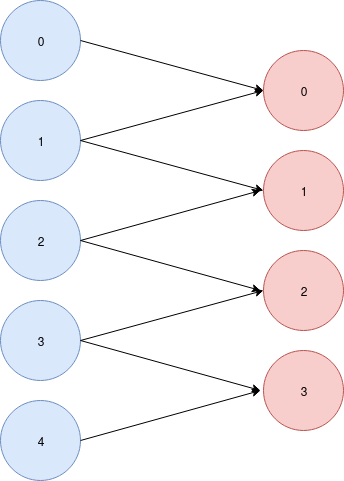
Red : previous labmda instanciation, Blue : our conv operator instanciation.
Distribution
The first think you have to do is the Distributor class. This class will generate the link between the previous and the next layer.
It class shall implement the Dispenser interface which contain a distribute function. This function take one argument equals to the previous layer size and must return a graph link data structure.
This data structure is pretty simple. It is a list with one element per lambda instance in the new layer, in our example the list will contain 4 elements. One element is a list of index that represent a dependancy. All index in this data structure are relative to previous layer order (number writen in the red node).
If we execute this function with the provided example above, we have to find out this result :
ourDispenser.distribute(5) -> [ [0,1], [1,2], [2,3], [3,4] ]
Now we have to code this ! You can find my implementation bellow, it’s not essential so I wont explain it.
class ConvOpDispenser(pyLambdaFlow.Dispenser):

    def distribute(self, size):

        dep_data = list()
        for i in range(size-1):
            dep_data.append([i,i+1])

        return dep_data
Now we can create our operator this by using the previous class.
class ConvOp(pyLambdaFlow.Operation):
    def __init__(self, parent, funct, name=None):
        super().__init__(parent, funct, ConvOpDispenser(), name=name)
That’s it ! You should be able to use this in your own project ! But keep in mind that your kernel should take only one argument, even if you provide multiple data.
Multi Sources
An other good feature is the multi source behaviour. You can use your custom operator with multiple layer. pyLambdaFlow will use your Dispenser function twise (with the first and the second layers) and provide data to your kernel.
But your kernel have to handle multiple arguments. For instance, I can use the ConvOp operator and provide two differents sources like this :
Here is a main script sample.
a = pyLambdaFlow.Source()

b= pyLambdaFlow.Source()

c = ConvOp([a,b]) # Multi source definition
Your kernel has to handle 2 arguments :
def lambda_handler(left, right):

    return (left[0]+left[1]+right[0]+right[1])/4